Demolition and brickwork
Demolition looks like the simplest part of a renovation and tends to be the riskiest. Taking out a partition that carries nothing is routine. As soon as a load-bearing wall is touched, an opening is cut or the layout of an apartment building changes, it is the structural engineer and the building authority who decide, not the crew on site. Filling in and new brickwork are the same thing in reverse: a new layout goes up, openings are closed, lintels are set.
What is load-bearing and how you tell
You cannot reliably tell by looking at a wall. Neither thickness nor material decides on its own; in a panel building a relatively thin wall may carry load, while in a brick building a thick partition is often only infill. Certainty comes from the building's documentation or from a structural engineer's assessment. In an apartment building the consent of the owner or the owners' association is almost always added as well, because the work touches shared structure.
Building Act 283/2021 Coll. distinguishes maintenance work, which needs no permit, from projects for which a building authority permit is required. Work on load-bearing structure falls into the second group. The specific duty depends on what is done and where, so check it with your building authority; a general rule from a website does not take the responsibility off you.
If you are not sure what is load-bearing, write exactly that in the enquiry. It is a better starting point than an assumption the quote is then built on.
Openings, lintels and filling in
A new opening in a wall means a lintel to take the load above it. It is usually set before the opening is cut, so the structure is never left unsupported. Bricking up an opening is simpler but has its detail: the new brickwork has to be tied into the existing wall and the top joint packed tight, otherwise a crack appears at the junction and keeps coming back however often it is filled.
Filling in after services is small but important work. A chase left by the electrician or plumber is filled so that it holds the plaster and does not move. That is why it is made good before plastering, not at the end.
Debris, dust and life in the building
- Removing debris is usually a separate item, and for a flat on an upper floor without a lift its share is considerably larger.
- Dust is limited by covering, sealing doors and a site vacuum, but it cannot be eliminated.
- Apartment buildings have house rules and quiet hours. Say in advance whether there are restrictions so the schedule can allow for them.
- Living in the flat during the work is a different job from an empty one. It needs more covering, more cleaning and work in stages.
New brickwork and a new layout
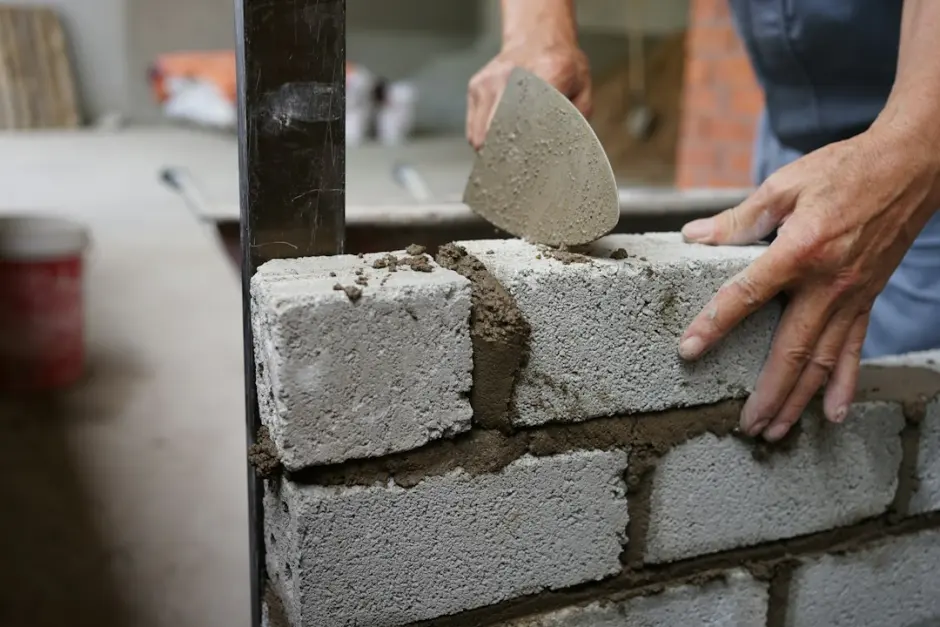
A new masonry partition is built from partition blocks, aerated concrete or solid bricks depending on what will hang on it and how it should behave acoustically. The comparison with drywall is on Drywall and partitions. What matters is that a masonry partition is a long-term decision: moving it later means demolition again, whereas drywall comes apart relatively cleanly.
Plastering follows, either straight away or after the services are finished. What comes next is described under plaster and stucco.
Other masonry work
Frequently asked questions
Can I take out a partition in a flat without a permit?
For a partition that carries nothing it is usually an alteration governed by the building's own rules, while work on load-bearing structure requires an engineer's assessment and the procedure under Building Act 283/2021 Coll. In an apartment building the owner's or association's consent is almost always added. Check with the building authority before you book a crew.
Who takes the debris away?
It can be you or the firm, which is exactly why it belongs in the quote in writing. A price list without materials typically excludes disposal. The quantity is also hard to estimate up front, so it is worth agreeing how it will be charged.
Can you demolish in a panel building?
It depends on the specific wall and on the building's rules. Panel systems have more load-bearing walls than people expect, and cutting into them is a serious matter. Nobody should touch it without an engineer's assessment and the building owner's consent.
Describe the job
No drawings or exact square metres needed. Write what should be done, what condition it is in now and when you would like it finished. We will ask about the rest.
- We pass the enquiry to a firm that does masonry work in your area.
- If we have no partner in your area, we say so straight away instead of leaving you waiting.
- Photos of the current state help the most. You can send them to [email protected].